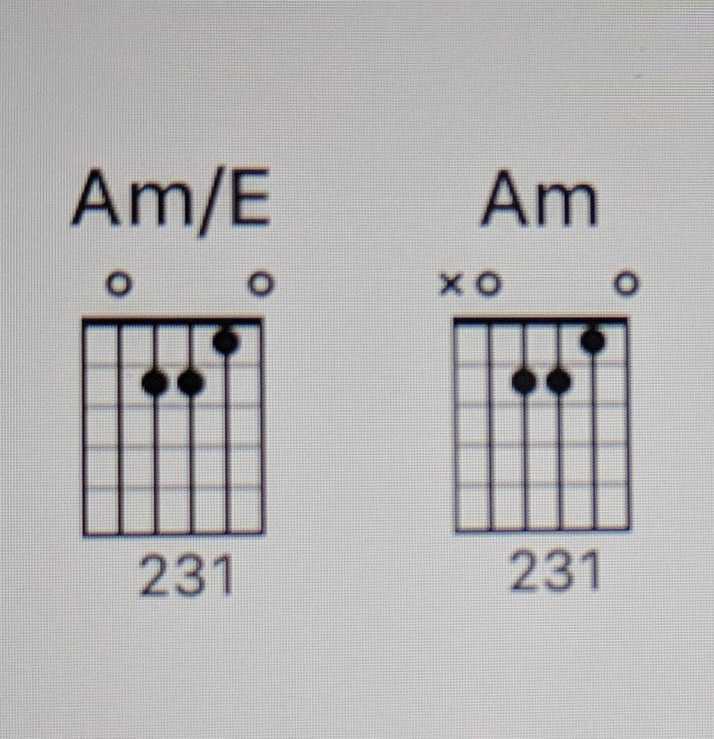
Guitarists, can I get some help? Based on the symbols shown, what am I supposed to do with the 6th string for the Am/E chord?
I'd guess it should be strummed open -- that's what makes it a second inversion chord -- but if so, why isn't it shown with the round circle above like other open strings?
Edit: I've seen unmarked strings (neither marked with an x nor with a circle) on other chords and from multiple sources, so I have to assume it actually means something and isn't just a typo.
 4
4


Enjoy being online again!
Welcome to the community of good people who base their values on evidence and appreciate civil discourse - the social network you will enjoy.Create your free account
8 comments
Feel free to reply to any comment by clicking the "Reply" button.
In these days, Google is a handy tool. For your reading pleasure:
 evidentialist
Level 8
June 27, 2018
evidentialist
Level 8
June 27, 2018
0
If it's marked with an "X" - don't play that string.
If it's marked with an "O" - play it open.
If there's NO mark, it's optional. Obviously, playing the open E in the Am/E chord would be correct, but not mandatory.
 drumreaper
Level 5
June 26, 2018
3
drumreaper
Level 5
June 26, 2018
3
That's about what I was guessing, but thanks for confirming it!
You must listen to what you are playing, it need not agree with any chord chart, as notation goes it’s little more than a jumping off point. If you like what you played do it even if it’s wrong... follow the music grasshopper.
 ArdentAtheist
Level 8
June 26, 2018
1
ArdentAtheist
Level 8
June 26, 2018
1
yep pretty much agree with ken. Youd have to play the low E to make it sound like its label of course (and thats the third inversion btw, second inversion would have a C as the bass note). to me, x means to mute the string, an o would mean to play it open, but the absence of the x or o sorta means don't mute it but don't lay into it so hard either id kinda let it ring with the chord but not make it the focal point if that makes any sense.
 Wurlitzer
Level 8
June 26, 2018
1
Wurlitzer
Level 8
June 26, 2018
1
@PerbeMayhaps ok yeah the OP was correct I forgot and was thinking of first inversion as the original stacked triad. but of course first inversion is starting with the third scale degree, second inversion starting at the 5th. yeah apologies @cmadler you were correct there.

It's music. There's often not a right or wrong. Play both and see how much difference you think it makes to the tune/song. I don't really use chords much but i would take the x in the diagram to mean don't play this string and nothing above the diagram would make it kind of optional.
Chords, especially, on the guitar are often not an exact science. Music is about sound so your ears are often the most reliable indicators 
 JimmyM
Level 7
June 26, 2018
1
JimmyM
Level 7
June 26, 2018
1