Words to use in a simple model of science?
I have no experience in teaching science to very young children , but believe that they should be allowed as much freedom as possible to have that miracle of invention and fantasy called ‘Play ‘ as much available as possible. Play must be accessible at all ages and never talked down. After a particular age which must vary from child to child I think it would enhance science education to start to bring a bit more structure to their play by giving them their first insight into what we call science.
Basically I want to break down science into a simple set of processes - something we often do in teaching science method to older students. If we could do this sensitively without overcomplicating the theory then we could work on each separate process with exercises and games of enjoyment. At each stage it should be made plain the relevance to their own life so that science becomes a personal tool
I want your help in deciding which words to choose for the processes for the youngest ages . Basically I want every child to have and get used to ‘Eureka’ moments of discovery and realise that the magic feeling can be accessed for the rest of their life.
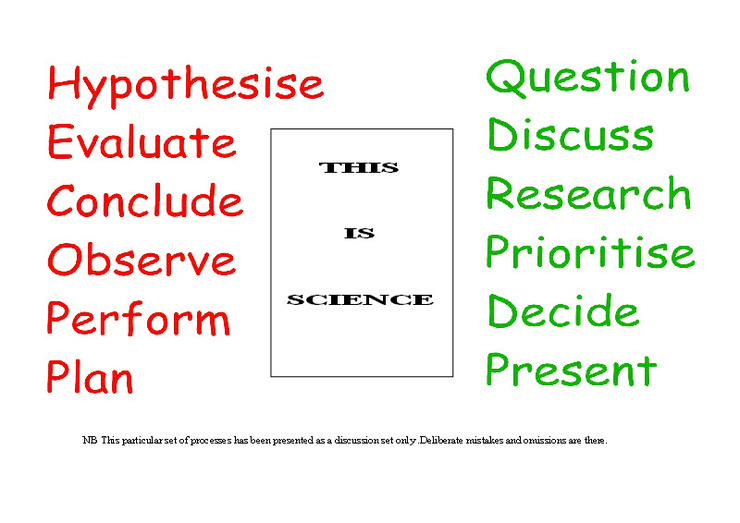
As an aid to your thinking I have chosen the following words but do not suggest that the list is in any way finalised . In fact I have deliberately left some processes out or used words which may not be ideal. It is important though that we do not overload the list with words that describe processes which will naturally happen without mentioning them and choose words which naturally lead on to games that can be played. You may already use this approach in your teaching so I would be grateful if you can relate any previous experiences.
HYPOTHESISE; QUESTION; EVALUATE; DISCUSS; CONCLUDE; RESEARCH; OBSERVE; PRIORITISE; PERFORM; DECIDE; PLAN; PRESENT
A possible arrangement could be
[agnostic.com]
Most of the words are processes which lead on naturally to further parts of a full investigation . For example asking a question should lead on to choosing the best formulation of the question which can be experimented upon ( the hypothesis) . This fact emphasises the cyclic nature of the scientific method.
0




Enjoy being online again!
Welcome to the community of good people who base their values on evidence and appreciate civil discourse - the social network you will enjoy.Create your free account


![[agnostic.com]](https://agnostic.com/images/posts/62206_tfpee7pck7x6p1f_full.jpeg?v=2)