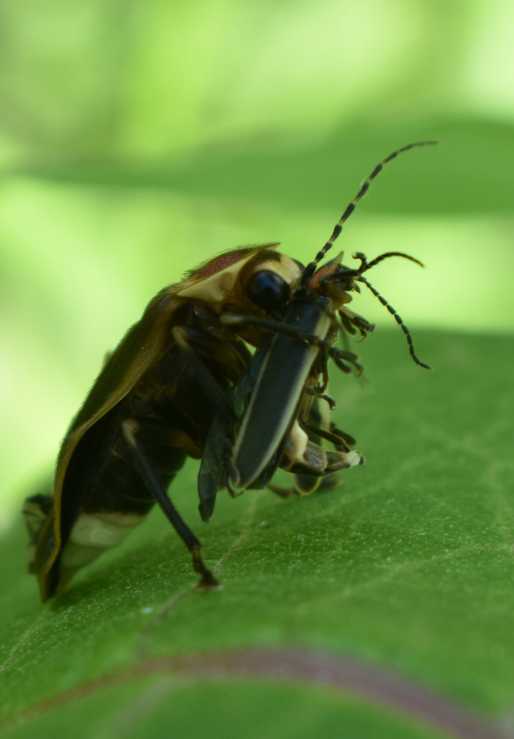
Since my parents are getting older they've lost interest (what little interest they had to begin with) in gardening. However, they're fine with letting the raised beds grow up with milkweed and dogbane. I was poking around their garden yesterday, looking for monarch larvae, when I came across a large species of firefly eating a smaller species of firefly. I knew they could be cannibalistic but this is my first time witnessing it. I didn't see any monarchs or their caterpillars but there was a huge, female, tiger swallowtail nectaring on the milkweed blossoms.


 8
8


Enjoy being online again!
Welcome to the community of good people who base their values on evidence and appreciate civil discourse - the social network you will enjoy.Create your free account
7 comments
Feel free to reply to any comment by clicking the "Reply" button.Beutiful and interesting shots.
Some species of fireflies evolved to feed on smaller ones.
Their larvae feed mostly on slugs, snails and small worms in and on the ground.
Fireflies spend two years underground as larvae, and live only one or two nights as adults.
A "flash" in the pan.
 Leafhead
Level 8
June 26, 2018
Leafhead
Level 8
June 26, 2018
0
Cool! I actually helped a fellow entomologist with field work in obtaining samples for an experiment and research consensus on fireflies in Colorado 2 summers back. We witnessed many female fireflies luring males of other species to them by mimicking their species flashing patterns and then consuming them. Sometimes even females of the same species would do the same thing and kill the male without even allowing him to attempt to mate with her.
 Mea
Level 7
June 25, 2018
1
Mea
Level 7
June 25, 2018
1

Great pictures and new and interesting info! Thanks!
 Free_2B_Me
Level 7
June 25, 2018
1
Free_2B_Me
Level 7
June 25, 2018
1
What range does milkweed grow ? I live in coastal NC and have two large lots . I remember seeing it up north but never down here .
 Besalbub
Level 8
June 25, 2018
1
Besalbub
Level 8
June 25, 2018
1
I would Google native Asclepias to your area.
You cannot go wrong with local Common and Butterfly Milkweed.
Avoid Tropical Milkweed
You must have a camera with you at all times. What do you use?
 dalefvictor
Level 8
June 25, 2018
1
dalefvictor
Level 8
June 25, 2018
1
@Insectra I guess you are prepared, that is a lot of gear.