Analysing silver from Phoenician hoards.
[sciencythoughts.blogspot.com]
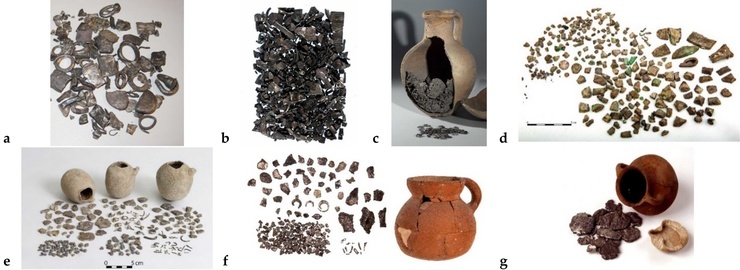
From about 4000 BC onwards the use of silver became widespread in the ancient world. This was obtained by smelting lead-ores in a furnace, and then cupellatiting (oxidising) the resultant metal to separate silver and gold. Lead ores, generally galena (lead sulphate) and cerussite (lead carbonate), were typically mined by a deep pit method, digging vertically down to a seem then following it horizontally. Silver was important to many ancient peoples, among whom were the Phoenicians, who built city states such as Tyre, Sidon and Byblos, ‘Akko and Dor in Lebanon and on the northern shores of the southern Levant during the Iron Age, roughly from the eleventh century BC onwards, and who travelled widely on trading expeditions, bringing innovations such as the alphabet, murex-based purple dyeing and masterful craftsmanship to the western Mediterranean, where they established colonies in North Africa, Sardinia and Iberia. In the ninth century BC the Phoenicians began to exploit jarosite (potassium-iron sulphate) ores in Iberia, from which silver was also extracted as a biproduct.

 13
13


Enjoy being online again!
Welcome to the community of good people who base their values on evidence and appreciate civil discourse - the social network you will enjoy.Create your free account
1 comment
Feel free to reply to any comment by clicking the "Reply" button.I wonder why people discovered smelting. Why would anyone want to melt rocks or even think it was posible. I wonder if they were considered mad while they experimented with melting things or if happened gradually enough that it didn't seem odd at all melting rocks at 1000 degrees C.
 Donna_I
Level 8
Jan 20, 2022
1
Donna_I
Level 8
Jan 20, 2022
1
JoeB:
Ancient peoples cooked on rocks, made things on rocks, and heated rocks to help change their properties before making tools from them. The first metals were probably a surprise (and possibly a nasty one, since one of the easiest metals to get this way is arsenic), but once you've got the idea...