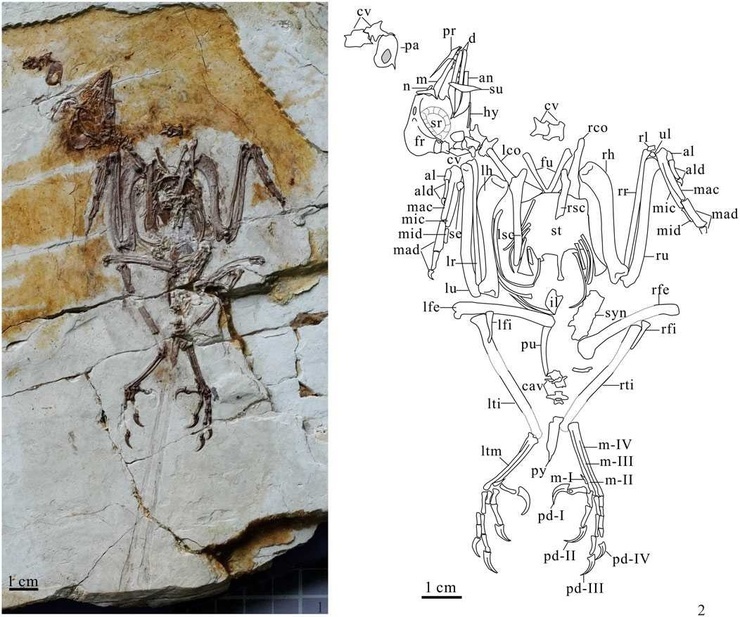
Musivavis amabilis: A new species of Enantiornithine Bird from the Early Cretaceous Jehol Biota of northeastern China.
[sciencythoughts.blogspot.com]
The Enantiornithines are the most diverse group of Cretaceous Birds known, with more than 50 described species from every continent except Antarctica. Although they were clearly widespread, more than half of all known Enantiornithines come from the Jehol Biota of northeastern China. The Jehol fossils are exceptionally well preserved, with many showing details of their plumage and internal organs, which has provided insights into these Birds ontogeny, sexual dimorphism, reproduction, and ecology. Most Enantiornithine Birds can be placed within four groups, the small-bodied and relatively unspecialized Cathayornithids, the long-snouted Longipterygids, and the large-bodied Bohaiornithids and Pengornithids, although there is some dispute as to whether these represent true clades (groups of organisms derived from a single common ancestor, or evolutionary grades (groups of organisms with the same level of organisation, but which do not share common ancestries).

 9
9


Enjoy being online again!
Welcome to the community of good people who base their values on evidence and appreciate civil discourse - the social network you will enjoy.Create your free account